PLANTING WITH PURPOSE
Companion planting,
with a job to do.
Give a flower planting a clear purpose, make room for it, and learn what it changes. A worked lettuce-bed example shows how to turn a promising pairing into a useful garden experiment.
Make an observation record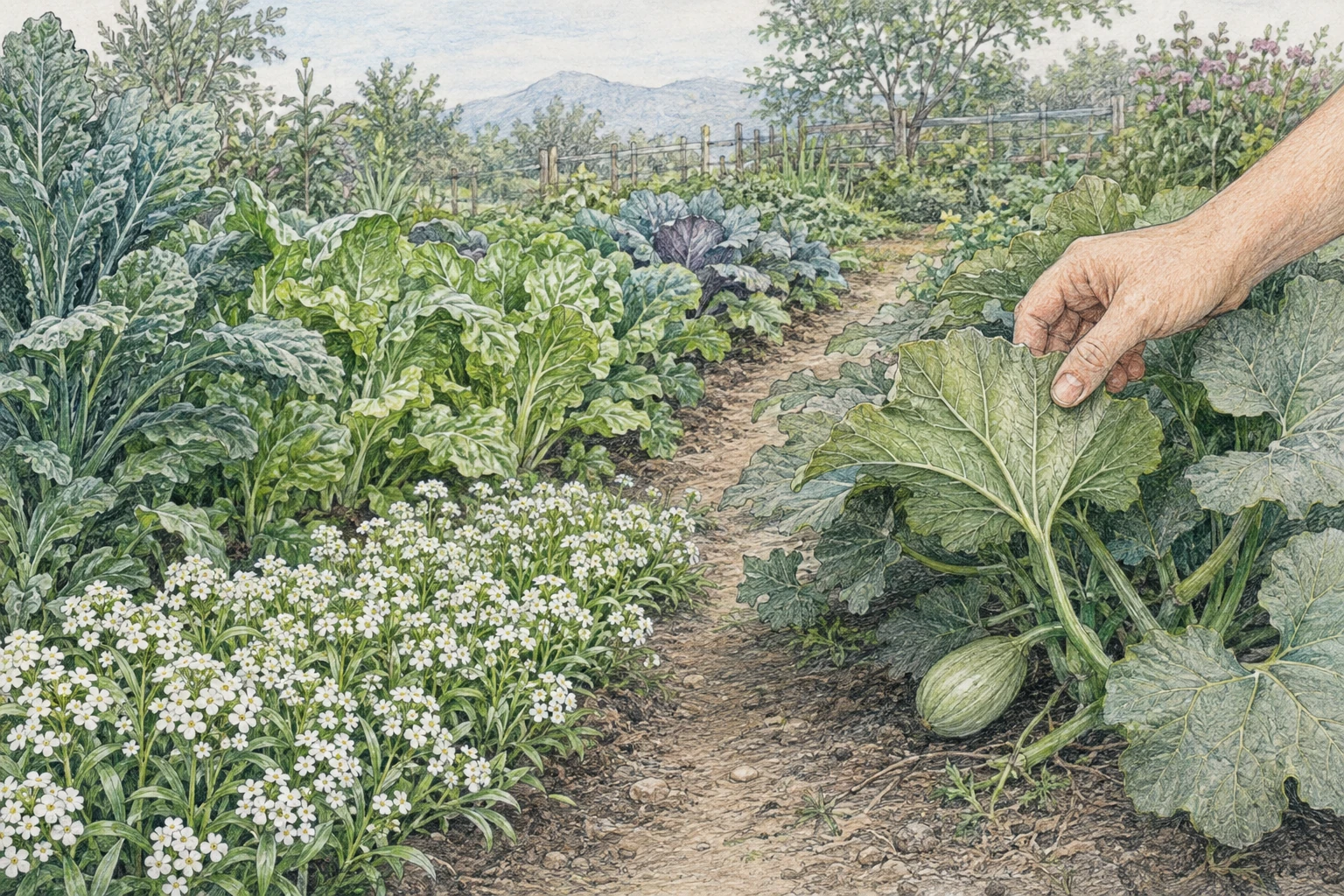
A few flowers beside the lettuce can make a bed more inviting. Whether they help with aphids is another question—and one worth asking carefully.
Begin with a job you can describe: “I want flowers available to insects that feed on aphids, without making the lettuce harder to grow or harvest.” That gives you a planting decision, a space budget and something to watch. “These plants are good friends” gives you none of those.
Keep the vegetable’s recommended spacing. Close planting makes neighbors compete for sunshine, water and nutrients. A companion still needs room to grow. [1]
A REASON TO TRY
Flower resources
Then crop observations
The flowers feed one life stage.
The next does the hunting.
In a California lettuce experiment, flowering sweet alyssum increased egg production by the hoverfly Eupeodes fumipennis. More larvae followed, and aphid numbers fell. This was a field-cage experiment: it supports the possibility of this useful chain of events, not a promise that every open lettuce bed will behave the same way. [2]
Many adult hoverflies feed on nectar and pollen. In aphid-eating species, the larvae do the hunting. A fly hovering over a flower and a larva feeding among aphids tell you different parts of the story. [7]
That distinction changes what you look for. Flowers in bloom show that a resource is available. Visitors show that something is using it. To learn about the lettuce, you have to return to the lettuce.
ONE OUTCOME IS NOT ANOTHER
Keep three notes separate: flowers and visitors, aphids on the crop, and crop condition at harvest. A busy flower strip is not, by itself, evidence of less damage.
A WORKED GARDEN DECISION · ILLUSTRATIVE
Give the flowers a place,
not the lettuce’s elbow room.
Imagine a bed where you have noticed aphids on lettuce in a previous crop. You want to try sweet alyssum with the next planting. You can reach the bed from a path, and another patch has lettuce of the same variety and planting date.
Draw the space before you fill it
- Mark the lettuce at its own spacing. Use the variety’s instructions. Then reserve a separate strip for the mature spread of your chosen alyssum. There is no proven attraction radius drawn here.
- Keep a way to reach the leaves. Picture yourself lifting a leaf without leaning through the flowers or stepping into the crop. Move the strip if it blocks that route.
- Choose plants to revisit. In this example, A1–A4 are four marked lettuces beside the flowers. B1–B4 are four comparable lettuces without added flowers. The number four is a convenient example, not a scientifically sufficient sample.
If the bed is already full
Remove some planned lettuce positions to make a real flower strip, or keep this crop’s layout and try flowers in a later planting. Squeezing flowers between established lettuces changes the crowding as well as the plant mix. You would be asking a different question.
And if there is no comparison patch? Use one patch. You can still learn whether the flowers bloom during the lettuce crop, whether you can reach the plants and whether the space feels well used. You will have less basis for deciding why aphid numbers changed.
TAKE THE SAME LOOK
A short routine
A useful record
Watch the crop before
you judge the pairing
UC IPM advises checking for aphids at least twice a week while plants are growing rapidly, turning leaves to inspect their undersides and looking for natural enemies as well as pests. Your flower experiment should fit inside that care routine. It should not postpone a needed response to damage. [8]
At the first visit, label the plants you will revisit and take an overview photograph. Record the crop variety, planting date, flower position and whether the alyssum is blooming. If the flowers are already open, call this your first observation, not a “before flowers” measurement.
At each visit, look over each marked plant using the same approach. In the simple record below, count a plant once if you find any aphids on it. Do not count each aphid. Record leaf condition and anything you did—washing off pests, harvesting leaves, feeding or changing the watering—alongside the count.
Then pause at the flowers. Write “open flowers; small flies visiting” if that is what you can identify. Do not turn an unfamiliar insect into a hoverfly just because the story would fit. A clear photograph is a better note than a confident guess.
WHEN YOU DO NOT KNOW WHAT IS WRONG
Gather a whole-bed photo, a close view of the affected leaf on both sides, and a photo of any insect. Add the crop, where the damage started, when you first noticed it and recent treatments. Ask an extension adviser: “What is causing this, and which observation would help confirm it?” Identification comes before choosing a companion to fix it. [1]
A FILLED FIELD NOTE · FICTIONAL EXAMPLE
Fewer plants with aphids.
What can we actually say?
Both patches have the same lettuce variety and planting date. Four marked plants in each patch are checked at both visits. The dates and counts below are invented to teach interpretation.
| Visit | A · beside flowers | B · comparison |
|---|---|---|
| June 4 | 3 of 4 | 2 of 4 |
| June 8 | 1 of 4 | 1 of 4 |
- Flowers & visitors
- Alyssum open on both visits. Small flies seen; identity uncertain.
- Crop & care
- No newly noticed leaf distortion. No leaves harvested or pests washed off between these visits. Both patches watered as usual.
- What changed
- A had aphids on two fewer sampled plants; B had aphids on one fewer. Both patches changed in the same direction.
- Next step
- Keep this strip for the current crop: the notes report no newly noticed leaf distortion and no recorded care change. Photograph the visitors. At picking, decide whether its flowers and access were worth the space; no claim of aphid control yet.
The tempting conclusion: “The flowers worked.”
The useful conclusion is smaller: aphid presence declined in both samples. The gardener can continue the modest trial without advertising it as a successful treatment. The flower patch started with more affected plants, so its larger drop does not establish a flower effect. These counts also say nothing about how many aphids were on each affected plant.
Other explanations remain possible. UC IPM notes that aphid populations can fall as natural enemies act or hot weather arrives. A decline beside flowers therefore needs more context than a before-and-after count. [8]
A comparison patch helps you notice that wider change. It is not a sealed control: insects can move, patches can differ, and your sample is small. Keep the result as a lead to follow, not a score for the pairing.
WHAT YOUR NOTES CAN TELL YOU
Keep, adjust,
or ask a better question.
Flowers open, visitors present
The resource is being used. Keep recording the crop; visitors alone do not establish protection.
Both patches improve
Something may be changing across the garden. Record weather and care; do not assign the whole improvement to flowers.
Only the flower patch improves
That is a pattern worth checking again with comparable plants. One small comparison still cannot establish its cause.
Lettuce crowds the flowers, or the strip blocks picking
You have learned something useful even without a pest result: this arrangement needs changing. Space and access are part of whether a pairing earns its place.
CHANGE THE JOB, CHANGE THE PLAN
Some companions ask
for a different commitment
The lettuce example keeps flowers and vegetables growing together. A trap crop adds a place to manage pests. A marigold pre-crop may take the vegetable’s place for a while. Choose between those jobs before buying plants.
MANAGED TRAP CROP
Known squash bugs
Hands-on care
A decoy needs a gardener
In small 2021 trials at two northern Utah research farms, New England Blue Hubbard grew at the ends of pumpkin rows. It was planted two weeks before Howden pumpkins. Pumpkins in those plots had fewer squash bugs and eggs than pumpkins without the trap crop. The plots used plastic mulch and drip irrigation; this was a particular system, not a universal schedule. [3]
The treatment included hand removal of squash bugs and eggs from the Hubbard plants. That work belongs in the recommendation. Planting the decoy and walking away is not the treatment that was tested. [3]
BEFORE YOU GIVE IT SPACE
Use this as a reason to ask your local extension service about a squash-bug trap crop. Plan how you will reach the plants and remove pests. This example does not establish control of squash vine borers, which are a different pest.
BEFORE THE VEGETABLE
Soil diagnosis first
Bed space required
Marigolds may need the whole bed
Marigolds for nematodes are a different sort of companion planting: the useful crop may come before the vegetable. UF/IFAS recommends a dense marigold crop in the same soil at least two months before the susceptible vegetable crop. Marigolds need suitable growing weather; that Florida guidance is not a calendar for every climate. [4]
Match the marigold variety to the nematode identified in your soil. Some combinations suppress nematodes; others let them multiply. Get a soil assay and local advice before surrendering a bed to the wrong variety. [4]
A few marigolds beside a susceptible vegetable are not a dependable substitute for that pre-crop treatment. Grow them for their flowers if you like them; give nematode management its own plan. [4]
AND THE FAMILIAR PAIRINGS?
Keep the useful part
In the Three Sisters tradition, corn supports climbing beans and squash shades the ground. The nitrogen fixed by beans is not immediately available to the corn. Treat it as a growing system worth learning, not a shortcut around crop nutrition. [5]
Leave room for doubt
A Minnesota cabbage study tested nasturtium, thyme and rosemary as companion plants. On most sampling dates, interplanting did not change pest populations. That is a good reason to stop promising that nasturtiums protect every brassica bed. [6]
Basil beside tomatoes can simply be two crops you want to harvest. You do not have to credit it with pest control to enjoy the combination.
FROM OBSERVATION TO A NEXT STEP
Read two visits together.
Use this for aphids you have identified on the same marked plants at two visits. It summarizes presence counts; your notes carry the crop condition, weather and care that the numbers leave out.
Open the observation worksheet on its own ↗
No comparison patch is required. If plants were replaced or harvested between counts, or care differed, mark the visits as not comparable.
A blank card to take outside
Copy this before the first visit. Keep the plant labels fixed; add a new row when you return.
Bed / variety: __________________ Planting date: __________
Flower position / planting date: __________________________
Marked plants: __________ Comparison patch, if any: __________
| Date | Aphids present / plants checked | Flowers, visitors, crop condition & care |
|---|---|---|
| ________ | A: ____ / ____ B: ____ / ____ | ________________ ________________ |
| ________ | A: ____ / ____ B: ____ / ____ | ________________ ________________ |
Next check / question: ___________________________________
Let the planting earn its place
You may keep the flowers because they bloom when the lettuce is growing, bring visitors you enjoy and leave enough room to pick. You may move the strip because the layout is awkward. You may see a pest pattern worth repeating next season.
Those are useful outcomes. Write down which one you actually found, and you will have a better starting point than a chart of plants said to like each other.
About this editorial preview
Independent AI evidence review completed September 6, 2026; no human review claimed.
For your garden
Your saved garden details
Choose a garden and bed to see your saved zone and soil details alongside the guide. Missing details stay marked as not recorded.
Enable JavaScript to connect your garden. The article and sources are available without it.